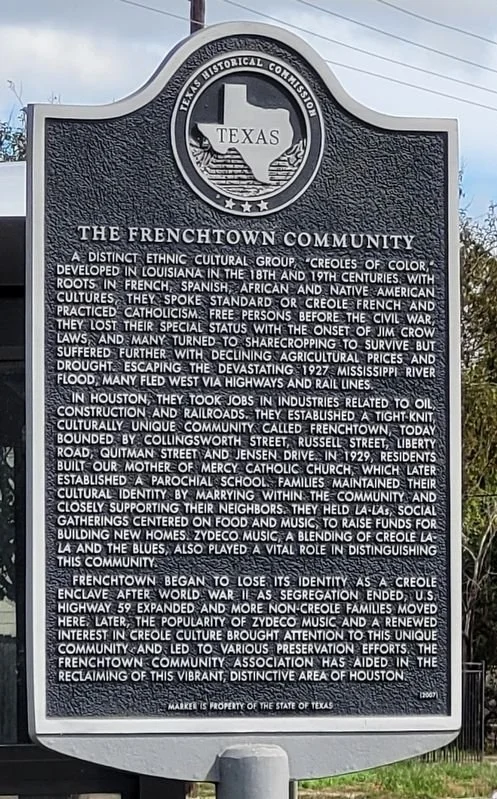
Frenchtown, on the northern edge of Houston’s Fifth Ward, became one of the city’s most important Louisiana Creole communities. According to the Handbook of Texas, approximately 500 Creoles of French, Spanish, and African descent organized the four-square-block neighborhood in 1922. These Creoles of Color were part of a broader movement from Louisiana into southeastern Texas. They did not arrive in a single migration or establish every Houston Creole community at once. Frenchtown is the best-documented early concentration, not a complete map of every place where Creole families later lived.
Houston’s expanding economy drew the first Frenchtown residents during the 1920s. Many were skilled or semiskilled workers recruited by the Southern Pacific Railroad, including mechanics, carpenters, sawmill workers, and bricklayers. Others found employment in oil-related businesses and industries along the Houston Ship Channel. Additional Creoles arrived after the Great Mississippi Flood of 1927, and wartime employment encouraged another migration wave during World War II. These movements connected Louisiana families to Houston through employment and kinship while allowing relatives, religious practices, foodways, and music to remain central to community life.
The neighborhood’s geography must be described carefully. The Handbook of Texas identifies its 2010s boundaries as Collingsworth Street on the north, Russell Street on the east, Liberty Road on the south, and Jensen Drive on the west. Those modern reference points should not automatically be treated as the exact boundaries of the original 1922 settlement. Residents lived largely in shotgun houses, traveled by streetcar, and sometimes constructed homes with lumber from retired Southern Pacific boxcars. The name Frenchtown was commonly used by residents and outsiders by the late 1930s.
Frenchtown’s largely French-speaking Catholic population maintained a recognizable Creole culture. Historical accounts describe language, religion, cuisine, music, family ties, and neighborhood social life as important markers of identity. Some children were ridiculed at school for speaking French, and some parents eventually discouraged its use to ease assimilation. Today, Kouri-Vini is used as a name for Louisiana Creole, but applying that modern label to every language variety heard in historical Frenchtown would exceed the available evidence. Sources often describe residents’ speech more broadly as French or Creole French.
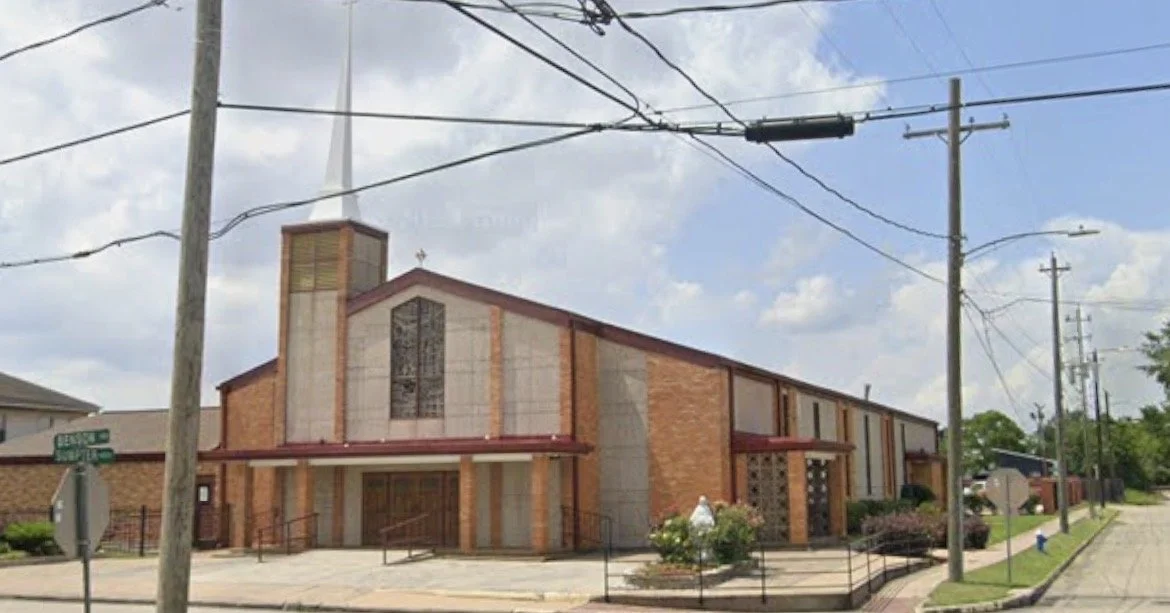
Our Mother of Mercy Catholic Church
Our Mother of Mercy Roman Catholic Church became the community’s institutional center. Before having their own parish, residents traveled to St. Nicholas Catholic Church. By 1929, Frenchtown families had raised church funds through la-la dances and sales of gumbo, boudin, and pralines. The Handbook of Texas reports that the money was stolen before construction began, after which Southern Pacific donated another site. Residents constructed a church at Sumpter and Granger, where the first Mass was celebrated on June 9, 1929. The present parish stands at Sumpter and Benson, at 4000 Sumpter Street; its current building is not the original 1929 structure.
Music also linked private community life to Houston’s public entertainment scene. La-la music was played at house parties before the word zydeco became the dominant public label. The Handbook of Texas credits Irene’s Cafe in the Sixth Ward as Houston’s first venue to present zydeco publicly. On Christmas Eve 1949, musicians Willie Green and L. C. Donatto joined a porch gathering that attracted a crowd, and a woman named Irene invited them into her nearby cafe. Because this account rests on later recollection, it is best presented with attribution rather than as an uncontested origin story.
The Continental Zydeco Ballroom became the best-known Texas venue regularly featuring the music. Located at 3101 Collingsworth, it began as Charley Johnson’s Johnson’s Lounge in the 1940s. After the success of Creole musicians at Irene’s, Johnson hired accordionist Alfonse Lonnie Mitchell around 1951. Mitchell later leased the business and renamed it Mitchell’s Lounge. When the lease expired, the property reverted to Johnson’s granddaughter, Doris McClendon, who renamed it the Continental Zydeco Ballroom and vigorously promoted its performances. The ballroom closed after McClendon’s death in November 1997.
Frenchtown changed after World War II. Desegregation allowed later generations to move elsewhere, marriages connected residents with the larger Black community, and construction of U.S. Highway 59 cut through the neighborhood. Frenchtown gradually merged into the Fifth Ward and lost some of its geographic distinctiveness, but its cultural influence continued. Our Mother of Mercy, historic markers, family memories, and Houston’s zydeco tradition preserve important parts of that history.
As a Creole born and raised in Houston, I see this history as part of the city’s living identity. The evidence does not support claiming that every Houston Creole family followed the same route or settled in the same neighborhood. It does show that Louisiana Creoles created durable institutions, developed musical spaces, and maintained cultural ties while adapting to a growing Texas city. Houston therefore became a major center of Creole continuity in Texas. Their story is not simply one of departure from Louisiana. It is a history of community building that helped shape Houston.
Jeffery Mitchell is a Houston-born Creole researcher, writer, and cultural advocate dedicated to documenting the Louisiana Creole experience in Texas. Born and raised on Houston’s south and southeast sides, he explores the history, language, music, foodways, neighborhoods, and family traditions that connect Louisiana Creoles to the Bayou City. His work emphasizes accurate research, community memory, and the preservation of Kouri-Vini for future generations.