An Identity Tightrope: The Balance Between Who You Are and Who You Are Deemed to Be
I think James Baldwin said it best: “The place in which I’ll fit will not exist until I make it.” As the child of a white German mother and an African American father, that line resonates deeply with me. It captures the mindset I’ve had to develop around identity—not searching for a space that will accept me but shaping one that feels authentic. It also means refusing to let others define who I am or how I should identify. Instead, it’s about being true to myself, recognizing that each journey is different.
When I meet new people, two questions tend to come up. The first is, “What are you?”—usually a way of asking about my racial background. Once I answer, the follow-up is often, “Which side do you identify with more?” On the surface, they seem like innocent questions. But for me, they carried assumptions and expectations that took time to recognize and work through.
My mother used to tell me to answer “human” when asked what I am. It was clever, and sometimes it earned a laugh, but it rarely ended the conversation. I still felt pressure to give a “real” answer. And once I did, it often triggered a firestorm of internal questions I didn’t yet know how to resolve. Do I have to choose? What does choosing even mean? Am I betraying part of myself if I lean one way over the other? What will others think about how I chose?
Learning about history, that tension sharpened and the questions became heavier. How can I align myself with a side that has done such harm throughout the world? And at the same time, how could I not feel deep empathy for the side that has been mistreated and has suffered throughout history? What started as simple curiosity from others turned into something more complicated within me—loyalty, guilt, pride, unworthiness, and confusion, all at once.
Over time, those questions didn’t disappear, but they became easier to hold. Today, I am as proud to be German as I am African American. One of the things I admire most about German culture is its directness—there’s very little sugarcoating. People on that side of my family tend to mean what they say and say what they mean. I also deeply value the spirit and resilience of African-Americans and other black people in the diaspora. Despite a long history of oppression, there is a persistent strength, creativity, and refusal to give up. I see it in the way challenges in my family are met with persistence, humor, and expression rather than defeat. These aren’t abstract traits to me—they are patterns I’ve grown up with and try to carry into my own life.
Through reading different perspectives on identity, reflecting on my own experiences, and examining the expectations and influences around me, I’ve come to understand that identity isn’t something I have to reduce to make it easier for others to understand. The need for connection is real, but it doesn’t require me to divide myself. My identity is not a choice between two sides; it is the space where both exist at once. I don’t have to choose—and if I ever do, that choice is mine alone. More importantly, I’ve learned that identity is not about finding where I belong, but about having the courage to create that place for myself.
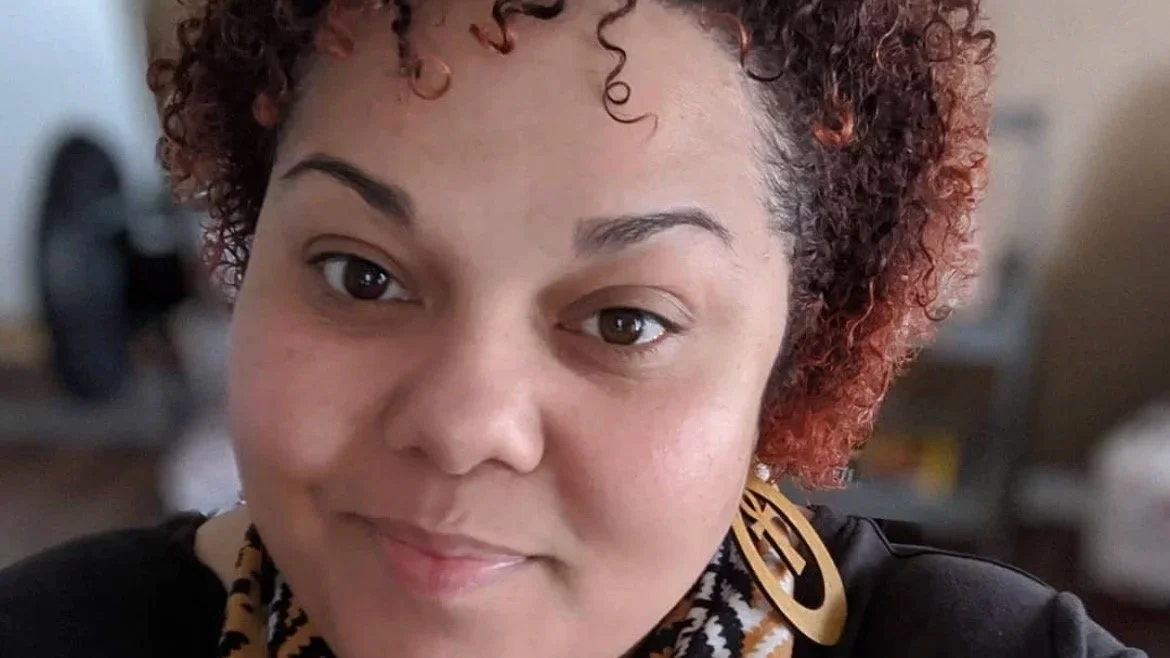
Natascha Froehlich
Natascha Froehlich, born in Germany, works as a paralegal with Legal Aid Services of Oklahoma. She is a mother of two. She is dedicated to providing equitable legal services across socio-economic borders. She is a lover of art, music, literature, and she draws much inspiration from figures such as Toni Morrison and James Baldwin